

Moisture and insulation performance
Water vapour behaviour in building structures
Unlike liquid water, water vapour can diffuse more easily through materials when a difference in temperature and vapour pressure exists between the two sides of a building structure.
If not properly managed, moisture can affect the performance of insulation, increase thermal conductivity and promote condensation within the building assembly.
Water has a thermal conductivity of approximately
0.56 W/mK, significantly higher than that of the main
insulation materials. Even a limited amount of moisture can therefore
noticeably reduce the insulating performance of a material.
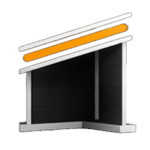
δp
Water vapour permeability
Water vapour permeability indicates the amount of water vapour that can
pass through a material when there is a difference in vapour pressure
between its surfaces.
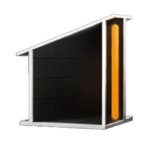
μ
Vapour diffusion resistance
The dimensionless factor μ indicates how many times
a material resists water vapour diffusion more than a layer of air
of the same thickness.
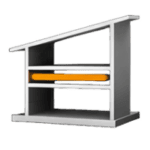
λ
Thermal performance
Moisture within a material can increase its thermal conductivity.
To maintain high performance, insulation should remain as dry as possible
throughout its service life.
How the μ factor is calculated
The water vapour diffusion resistance factor is the ratio between
the water vapour permeability of air and that of the material being considered.
Formula
For air, the reference value is μ = 1.
Open-cell and closed-cell materials
Most building materials are permeable to water vapour to varying degrees.
The internal structure of a material has a significant influence on the rate
at which water vapour can pass through it.
More open structure
Lower vapour resistance
A material with a more open structure and a lower μ factor allows
water vapour to diffuse more rapidly. If the building assembly is not
properly designed, this may increase the risk of moisture accumulation.
Closed-cell structure
Higher vapour resistance
Closed-cell materials generally provide greater resistance to water
vapour diffusion and lower sensitivity to moisture absorption.
The risk of interstitial condensation
The main risk occurs when water vapour passes through the building assembly,
reaches a sufficiently cold area and condenses within the construction layers.
The presence of water can alter the properties of the insulation, reduce
its efficiency, contribute to deterioration and compromise the durability
of building components.
Indicative comparison
Thermal conductivity and vapour resistance of insulation materials
| Property | XPS | EPS | PIR/PUR with permeable facings | PIR/PUR with impermeable facings | Mineral wool | Wood fibre |
|---|---|---|---|---|---|---|
| Thermal conductivity W/mK | 0.032–0.038 | 0.033–0.050 | 0.025–0.028 | 0.022 | 0.034–0.044 | 0.038–0.050 |
| Indicative μ factor | 80–150 | 20–60 | 30–50 | Very high | 1–2 | 4–8 |
The values are indicative and may vary depending on the product,
density, thickness, facing and the relevant technical declaration.
Ediltec solutions
Products with different levels of vapour resistance
Ediltec offers extruded polystyrene
X-FOAM® products and
POLIISO® polyurethane panels with different facings
to meet a wide range of design requirements.
The choice between a more vapour-permeable product and a product with
high vapour-resistance facings should be based on the building assembly,
application, environmental conditions and expected hygrothermal behaviour.
Indicative characteristics of Ediltec product ranges
| Property | X-FOAM® with extrusion skin | X-FOAM® without extrusion skin | POLIISO® AD / EXTRA | POLIISO® PLUS | POLIISO® ED / SB / VV |
|---|---|---|---|---|---|
| Thermal conductivity W/mK | 0.032–0.036 | 0.032–0.036 | 0.022 | 0.022 | 0.025–0.028 |
| Indicative μ factor | 100–150 | 80 | Very high | 125 | 30–50 |
Vapour control layer or vapour barrier?
Depending on the construction type, internal relative humidity,
intended use and temperature differences, it may be necessary to combine
the insulation with a specific vapour control layer.
Vapour control layer
Limits and regulates the passage of water vapour without completely
preventing it, helping to control the moisture balance within the
building assembly.
Vapour barrier
Provides very high resistance to vapour diffusion and is used when
it is necessary to strongly limit the entry of water vapour into the
building assembly.
Hygrothermal assessment of the building assembly
The choice of insulation material should not be based exclusively on its
thermal conductivity. Resistance to water vapour diffusion and the behaviour
of the entire building assembly must also be considered.
A hygrothermal assessment, carried out according to the applicable methods
and standards, makes it possible to identify the risk of surface or
interstitial condensation and to correctly design the position of any
vapour control layers or vapour barriers.