

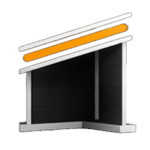
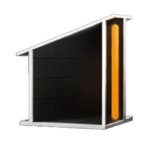
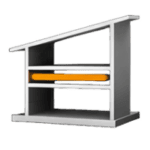

A typical phenomenon of the upside down Roof is the “dwell”. This phenomenon is a consequence of the fact that the meteoric water penetrates between slab and slab, it comes in contact with the warmer layers under the insulating mantle and is eliminated from the discharges together with the calories removed from the roof. The phenomenon is based on the rainfall of the area that can be known through the tables of daily average rainfall published by the Italian Institute of Meteorological Statistics. From this basic concept, studying the experimentally, various national institutes such as French CSTB and the Berlin Institute, have highlighted formulas that can serve to calculate the phenomenon. This phenomenon becomes appreciable in geographic regions characterised by high rainfall. A correlation to be used in a simple way can be: (01)
- R% is the percentage of thermal resistance that is attributable to the structure, excluding the X-FOAM® Layer
- Var U is the increase of the total transmittance to have that useful for the purposes of thermal calculations

It should be noted that if the percentage of thermal resistance of the X-FOAM® panel on the total is less than 45%, then the increase of the transmittance of the structure due to the unscrewing becomes null. Example of calculation of the transmittance increase: With a total transmittance U = 0,924 W/M2K and a resistance of the structure R% = 39 (02). So the total transmittance of the structure for the calculation is: (03)